
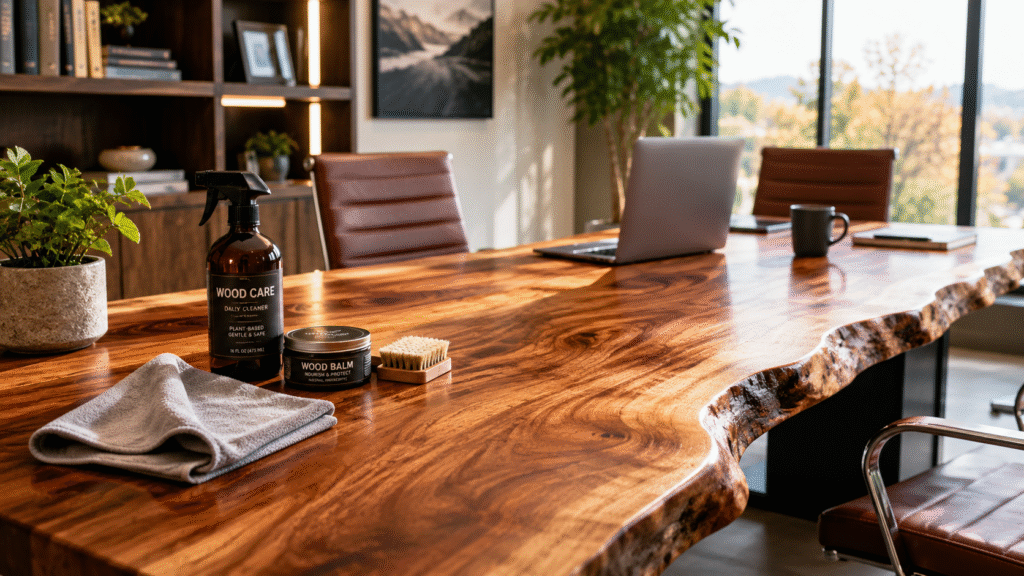
How to Care for a Live Edge Wood Table: The Complete Daily and Weekly Guide
A live edge table is a long-term investment.
Done right, it lasts decades. Done wrong, it needs refinishing in a few years.
This guide covers exactly what to do, what to avoid, and how care differs between home tables and commercial settings.
Quick Reference: What Damages Live Edge Tables
The four biggest threats to your table:
- Standing water that soaks into the finish
- Heat from dishes, laptops, or radiators
- Wrong cleaning products (Windex, Pledge, Lysol wipes)
- Low humidity that dries the wood and causes cracks
Avoid these four and most problems disappear.
Know Your Wood (It Affects Care)
Different hardwoods handle wear differently. The Janka hardness scale measures how much force it takes to dent the wood.
| Wood Species | Janka Hardness (lbf) | Dent Resistance |
|---|---|---|
| Hard Maple | 1,450 | Most resistant |
| White Oak | 1,360 | High |
| Red Oak | 1,290 | High |
| Walnut | 1,010 | Moderate |
| Cherry | 950 | Lower |
Source: ASTM D1037 testing data, Wikipedia Janka hardness test
Walnut is the most popular live edge wood, but it dents more easily than oak or maple. That matters when choosing coasters and pads.
Know Your Finish (It Changes Everything)
Most live edge tables use one of three finishes. Care differs significantly between them.
| Finish Type | Look | Maintenance | Repair |
|---|---|---|---|
| Hardwax oil (Rubio Monocoat, Osmo) | Natural, matte | Re-oil every 2-6 years | Spot repair possible |
| Polyurethane | Glossy or satin | Rarely needs upkeep | Requires full refinish |
| Epoxy resin | Glass-like | Wipe clean only | Difficult, often pro only |
Source: Rubio Monocoat USA care guide
Not sure which one is on your table?
Ask the maker. They will tell you exactly.
Daily Care (30 Seconds, Max)
Daily care is just prevention.
Wipe after every use. Soft microfiber cloth. Follow the grain.
Blot spills immediately. Press straight down. Never wipe sideways.
Use coasters. Always. Every drink, hot or cold.
Use trivets for hot dishes. Heat damages most finishes.
Don’t park laptops in one spot. The heat dulls the finish over time.
That’s it.
Weekly Care (5 Minutes)
Once a week, give the table a real clean.
Step 1. Dust with a dry microfiber cloth, following the grain.
Step 2. Lightly dampen a second cloth with plain water. Wring it out hard.
Step 3. Wipe the surface with the grain. Never leave water sitting.
Step 4. Dry immediately with a third clean cloth.
No sprays. No polish. No wipes.
What NOT to Use
This is more important than the cleaning steps.
| Product | Why to Avoid |
|---|---|
| Windex, 409, Lysol spray | Strips finish, leaves residue |
| Pledge and silicone polishes | Builds up, attracts dust |
| Lysol or Clorox wipes | Bleach and alcohol damage finish |
| Vinegar | Acidic, etches oil finishes |
| Ammonia | Breaks down protective oils |
| Magic Erasers | Microabrasion damages finish |
| Paper towels | Lint and micro-scratches |
When in doubt, plain water and a microfiber cloth.
The Humidity Problem (Especially in Canada)
Wood is hygroscopic.
It absorbs moisture from the air, swells in summer, contracts in winter.
The sweet spot: 40% to 60% relative humidity, with the wood itself sitting at 6 to 9% moisture content for furniture-grade hardwoods.
Canadian winters are the enemy. Indoor humidity often drops below 25% when the furnace runs.
The fix: a humidifier in the same room as the table from November through March.
Aim for 40 to 50% RH on a hygrometer ($15 on Amazon).
Re-Oiling Schedule for Hardwax Oil Finishes
If your table has a Rubio Monocoat or similar hardwax oil finish, you’ll need maintenance oil eventually.
| Setting | Re-Oil Frequency |
|---|---|
| Light home use (dining occasionally) | Every 2 to 6 years |
| Heavy home use (daily meals, kids) | Every 12 to 18 months |
| Light commercial (executive desk) | Every 6 to 12 months |
| Heavy commercial (boardroom, café) | Every 3 to 6 months |
Source: Rubio Monocoat USA recommends rejuvenation “usually between 2 and 6 years, depending on climate, use, and care.”
How to know it’s time:
- Surface looks dry or chalky
- Water no longer beads on the wood
- Light scratches show up easily
The process takes 15 minutes and dries in 6 to 8 hours. Full cure: 6 days.
How to Fix Common Problems
White water rings (light, cloudy):
The moisture is trapped in the finish, not the wood. Several methods work:
- Iron on low heat over a dry cotton cloth (move it constantly)
- Mayonnaise overnight, then wipe clean
- Hair dryer on low, held 6 inches away
Dark water rings:
The water has penetrated the wood itself. Most likely needs sanding and refinishing. Call your table’s maker.
Light scratches (oil finish):
Apply a drop of the same maintenance oil. Buff with a soft cloth in circles.
Light scratches (polyurethane):
Usually need a professional touch-up.
Sticky residue:
Almost always from the wrong cleaning product. Wipe with a barely damp cloth, dry immediately, and stop using that product.
Cracks along the natural edge:
Usually a humidity issue. Add a humidifier and the wood may close up on its own.
Commercial Tables Need a Different Playbook
Boardroom tables and executive desks see more abuse than home pieces.
The math:
- A home dining table sees about 1,000 to 1,500 uses per year
- A boardroom table sees 5,000 to 10,000 uses per year
- An executive desk sees daily 8-hour shifts
That’s why commercial live edge needs:
- Coasters in every meeting room. Non-negotiable.
- Refinishing every 2 to 3 years instead of every 5 to 10
- Written care instructions for the cleaning crew
The most common point of failure?
The cleaning staff.
A janitorial team used to laminate boardroom tables will reach for an all-purpose spray and damage a $5,000 walnut slab in weeks.
The fix: work with a professional office cleaning team that handles premium materials. The right partner knows that hardwood needs different products than glass, stone, or metal, and they adjust their protocols accordingly.
The Daily, Weekly, Yearly Schedule
| Frequency | Task | Time Needed |
|---|---|---|
| After each use | Wipe surface, blot spills | 30 seconds |
| Weekly | Damp wipe and dry | 5 minutes |
| Monthly | Inspect for new damage | 2 minutes |
| Quarterly (commercial) | Re-oil if hardwax finish | 15 minutes |
| Yearly | Check fasteners, base hardware | 5 minutes |
| Every 2-6 years (residential) | Re-oil if hardwax finish | 15 minutes |
The Bottom Line
Live edge tables are nature with a job.
Treat them like wood, not laminate, and they’ll outlast the room they sit in.
Wipe spills fast.
Use coasters.
Keep humidity at 40-60%.
Skip every product on the “don’t use” list.
That’s the entire care manual.
